


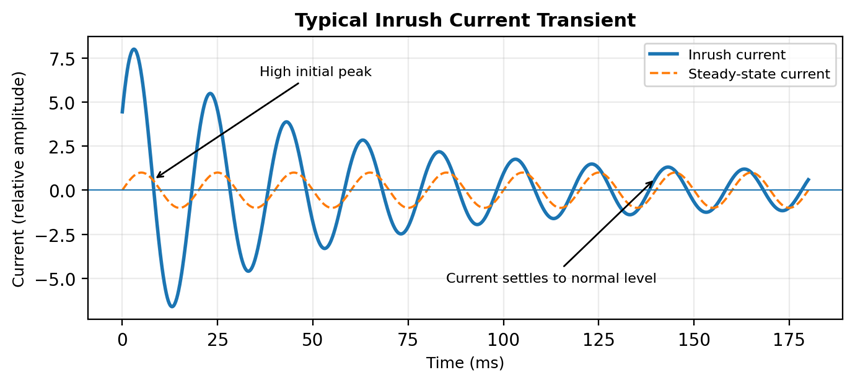
| What it is A temporary current surge that appears when equipment is first energized. | Typical causes Transformer energization, large motor starting, capacitor bank switching, and load pickup. | Why it matters It can trigger voltage sag, nuisance trips, and stress on electrical equipment. |
1. What is Inrush Current?
Inrush current is the short-duration current drawn by electrical equipment when it is switched on. For a brief moment, the current can be much higher than the rated operating current before returning to normal. This is a normal electrical phenomenon, not necessarily a fault.
The size of the surge depends on the type of load, the point on the voltage waveform when energization occurs, and the magnetic or mechanical condition of the equipment.
2. Common Sources
• Transformers: magnetizing inrush can reach several times rated current when the core is energized.
• Motors: starting current is high because the rotor must accelerate from standstill.
• Capacitor banks: charging current can spike briefly at switch-on.
3. Effects on the Power System
Although inrush current is temporary, it can cause a voltage dip in the network. Sensitive equipment may react to this dip by resetting or tripping. In industrial systems, this can lead to contactor dropout, PLC reset, VFD trips, or short interruptions in the production process.
Repeated inrush events may also increase thermal and mechanical stress on transformers, cables, breakers, and switching devices.
4. Inrush Current vs. Fault Current
| Aspect | Inrush Current | Fault Current |
| Condition | Normal energization event | Abnormal condition caused by a short circuit or equipment failure |
| Duration | Temporary and self-clearing | Persists until protection clears the fault |
| Effect | May cause voltage sag and nuisance trips | Requires immediate protective operation |
| Action | Usually tolerated by design | Must be interrupted quickly |
5. How to Reduce the Impact
• Use soft starters or variable frequency drives (VFDs) for large motors.
• Apply controlled switching for transformers and capacitor banks where suitable.
• Coordinate protection settings so temporary inrush is tolerated without compromising fault protection.
• Evaluate system voltage quality when sensitive loads are involved.
In short, inrush current is a normal but important phenomenon. Understanding it helps engineers choose the right protection, avoid nuisance tripping, and keep the power system stable during energization.