


Why Is This Technology Needed?
In medium-voltage distribution systems, faults such as tree branches touching conductors, animals, damaged insulators, underground cable problems, or phase-to-phase contact can trigger short-circuit currents. Conventional reclosers usually interrupt the fault, wait, and then close again several times to check whether the fault has cleared. If the fault is permanent, each reclosing attempt can inject a large fault current back into the network.
The problem is not only a momentary outage. Repeated high-energy testing can add thermal and mechanical stress to transformers, cables, conductors, joints, and protection equipment. Customers on the source side may also experience voltage sag or flicker. Therefore, a gentler way is needed to test line conditions before the line is fully closed again.
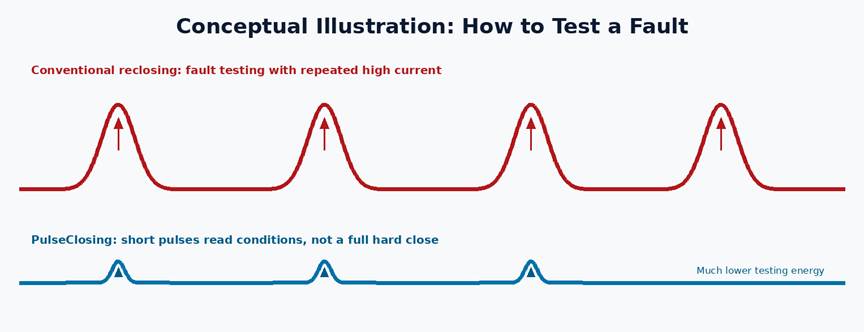
Figure 1. Conceptual illustration of the difference in testing energy between conventional reclosing and PulseClosing.
What Is PulseClosing Technology?
PulseClosing Technology is a fault-testing technology used in the S&C IntelliRupter PulseCloser Fault Interrupter. Its purpose is simple: to verify that the line is free of faults before the device performs a closing operation. S&C explains that this technology can use 95% less energy to test faults than a conventional recloser.
Technically, PulseClosing performs a fast, measured close-and-open operation on each phase, then analyzes the resulting current and voltage waveforms. If the waveform response indicates that the fault is still present, the device does not proceed to a full close. If the fault has cleared, the device can close more safely.
How It Works in a Simple Sequence
| Stage | What Happens |
| 1. Fault detected | Current and voltage sensors detect abnormal conditions, then the interrupter opens the line. |
| 2. Device waits | The control runs the protection sequence according to system settings and coordination. |
| 3. Test pulse is sent | The contacts perform a very short close-open action, not a long full close. |
| 4. Waveform is analyzed | Current and voltage responses are used to assess whether the fault is still present. |
How It Differs from a Conventional Recloser
| Aspect | Conventional Reclosing | PulseClosing |
| How the fault is tested | Closes the line again to see whether the fault is still present. | Sends a short pulse, then reads the waveform response. |
| Testing energy | High; each reclose can inject a large fault current. | Low; S&C states that testing energy is 95% lower [1]. |
| Impact on assets | May add stress to transformers, cables, conductors, and joints. | Reduces component stress and customer voltage sag on the source side [3]. |
| Application suitability | Common for distribution networks, but can be harsh during permanent faults. | Suitable for modern feeders, segmentation, automation, and protection of overhead and underground circuits. |
Main Benefits for Distribution Networks
| Less asset stress Fault testing does not repeatedly hit the system with full fault current. | Better power quality Voltage sag and flicker on the source side can be reduced. | Supports smart grids Compatible with sensors, SCADA, loop automation, and feeder segmentation. |
Conclusion
PulseClosing Technology makes fault testing more selective and gentler on the network. Instead of reclosing the line repeatedly with high energy, the device sends a short pulse to determine whether the fault is still present. The result is smarter restoration, lower equipment stress, and better power quality for customers. For increasingly complex distribution systems, this technology is an important approach to building a more reliable, safer network that is ready for the smart grid.