


Understanding power risks and how smart protection keeps continuous production lines running.
1. Introduction
Modern manufacturing facilities increasingly operate around the clock to maximize production capacity and meet tight market deadlines. Whether producing food, pharmaceuticals, automotive parts, or high-tech electronics, 24/7 facilities depend completely on a stable, continuous electrical supply. In a continuous production environment, even a split-second power glitch can stop heavy machinery, ruin entire product batches, and cost thousands of dollars per minute. Consequently, electrical reliability is no longer just a facility engineering concern—it is a critical business necessity.
2. Why 24/7 Operations Are Different
Unlike standard commercial buildings or single-shift workshops, continuous manufacturing plants place severe, uninterrupted demands on their electrical infrastructure:
- Continuous Electrical Load: Motors, pumps, compressors, fans, conveyors, and HVAC systems run continuously under heavy stress for weeks or months without a break.
- Limited Shutdown Windows: Maintenance teams cannot easily turn off power for routine inspections because any planned shutdown directly translates to lost output.
- High Cost of Downtime: An unexpected outage causes immediate production loss, equipment damage, product quality defects, and long restart procedures.
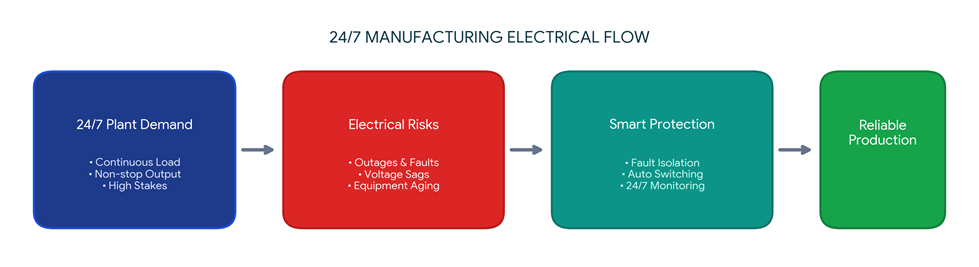
Figure 1. The 24/7 Manufacturing Electrical Cycle: From Continuous Demand to Reliable Production.
3. Five Key Electrical Challenges
A. Power Interruptions
Unexpected power outages—whether caused by external utility grid disturbances, lightning strikes, or internal equipment trips—stop sensitive production lines immediately. Even brief interruptions require lengthy manual resets and recalibration before production can safely resume.
B. Electrical Faults
Short circuits, ground faults, and overcurrent events release massive thermal and mechanical energy. Without rapid, reliable protection, a fault on one circuit can severely damage equipment and quickly spread across the entire plant network.
C. Power Quality Problems
Voltage sags, swells, and harmonics cause silent damage. Poor power quality overheats electric motors, disrupts sensitive electronic controllers (PLCs), and leads to unexpected micro-stoppages across automated assembly lines.
D. Equipment Aging
Transformers, switchgear, cabling, and circuit breakers undergo continuous thermal and mechanical stress. Over time, insulation deteriorates and contacts wear out, significantly increasing the likelihood of catastrophic failure if not monitored.
E. Maintenance Without Production Interruptions
Servicing high-voltage gear while keeping nearby production lines energized is a major operational challenge. It requires strategic sectionalization, redundant supply routes, and safe isolation equipment.
4. The Importance of Selective Fault Isolation
The most vital principle for 24/7 electrical reliability is clear: A power fault on one branch must never become a plant-wide shutdown. Advanced protection and switching equipment selectively isolate only the faulted section, allowing all unaffected production lines to keep running smoothly.

Figure 2. Selective Fault Isolation: Disconnecting only the faulted feeder while healthy lines remain energized.
5. How Modern Technology Helps
- Automatic Switching: Instantly isolates damaged circuits and transfers healthy loads to alternate power sources in milliseconds.
- Digital Protection Relays: Detect abnormal voltage or current spikes instantly, tripping breakers before equipment damage occurs.
- Predictive Condition Monitoring: Sensors continuously monitor temperature, gas levels, and insulation health, enabling proactive maintenance long before failure.
6. Key Features of a Resilient Electrical System
| Key System Feature | Primary Operational Benefit |
| Selective Protection Coordination | Isolates only the faulted section; keeps rest of plant running. |
| Redundant Power Paths (Loops) | Allows maintenance and fault recovery without total plant shutdown. |
| Automatic Transfer & Reclosing | Restores power automatically after temporary grid disturbances. |
| Real-Time Condition Monitoring | Detects overheating and insulation wear before catastrophic breakdown. |
7. Conclusion
For 24/7 manufacturing operations, electrical reliability is a vital pillar of business profitability. Power interruptions and unisolated faults cause costly downtime and equipment damage. By implementing modern protection devices, selective fault isolation, and continuous condition monitoring, manufacturers can turn potential power disasters into controlled, isolated events—ensuring continuous, safe, and profitable operations around the clock.