

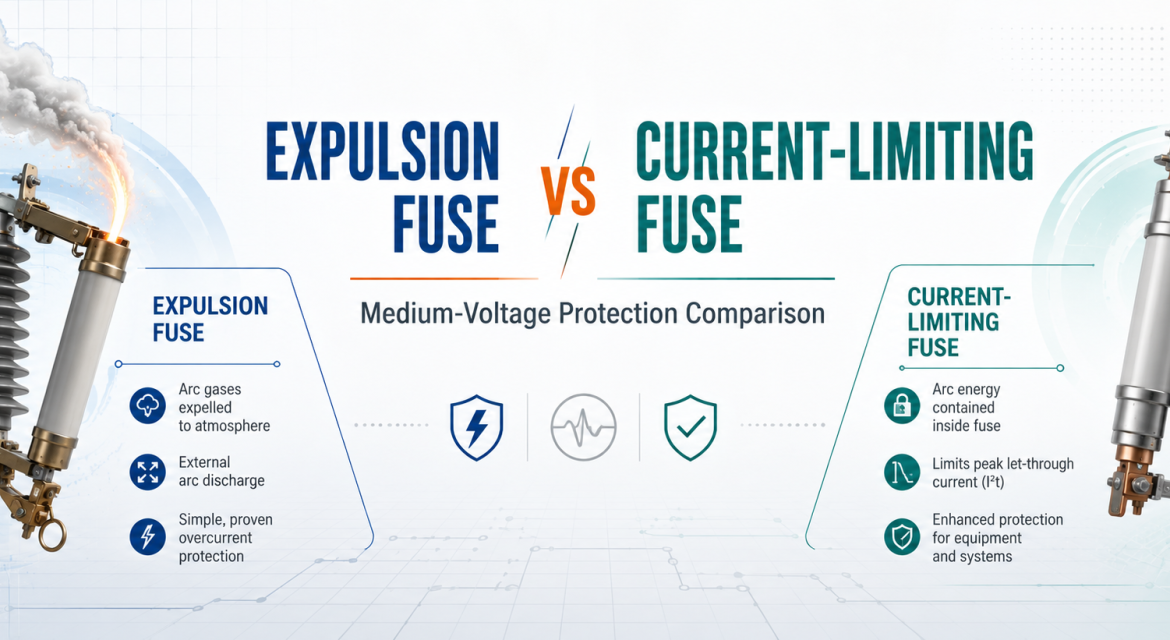
Focus: operating principle, arcing, exhaust, and applications in medium-voltage distribution protection
In medium-voltage distribution systems, fuses are used to interrupt fault current and protect equipment such as transformers, feeders, cables, and capacitor banks. Two concepts that are often compared are expulsion fuses and current-limiting fuses. Both generate an arc during fault interruption, but they differ in how they control the arc and fault energy.
1. Expulsion Fuse: arc extinguished by gas and exhaust
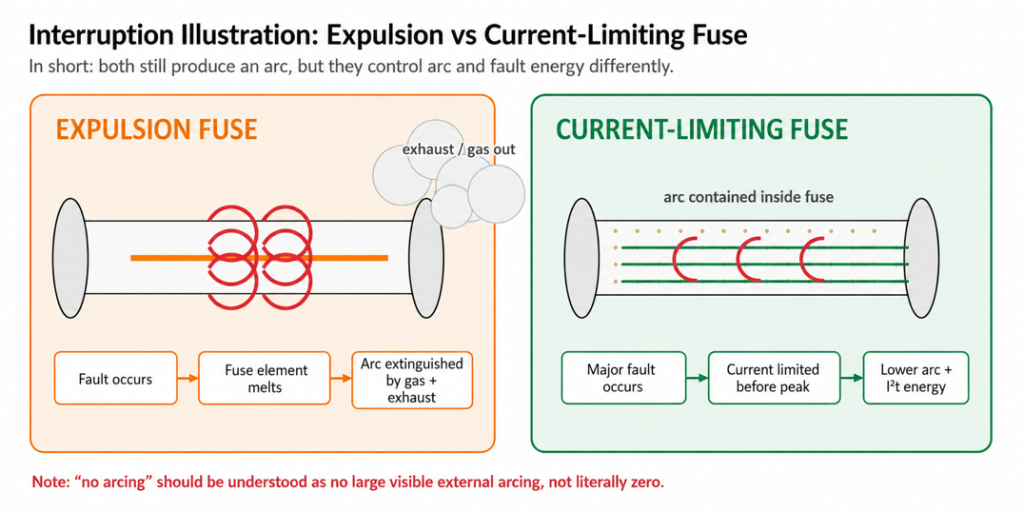
An expulsion fuse operates by melting the fuse element when fault current exceeds a certain limit. When the fuse element melts, an arc is created. This arc is then extinguished by gas generated from arc-quenching material inside the fuse tube. Because the interruption process produces pressure and gas, exhaust or outward discharge is usually present.
• Suitable for many overhead distribution applications because the construction is simple and operation is easy to identify visually.
• For small to medium faults, an expulsion fuse is effective in isolating the fault.
• Limitation: it does not significantly limit peak fault current, so fault energy can still be high.
• Arc and exhaust can be more visible from outside, especially compared with a fully enclosed fuse.
Key concept of expulsion
An expulsion fuse is not a poor solution; however, its characteristic is to release part of the fault energy through the arc-extinguishing and exhaust process. Therefore, installation must consider safe distance, exhaust direction, and clearance from other equipment.
2. Current-Limiting Fuse: arc contained and current limited
A current-limiting fuse operates very quickly during a major fault. This fuse not only interrupts the current, but also limits the fault current before it reaches its peak. The arc is controlled inside the fuse body, usually with an arc-quenching medium such as silica sand, so the energy released externally is much lower.
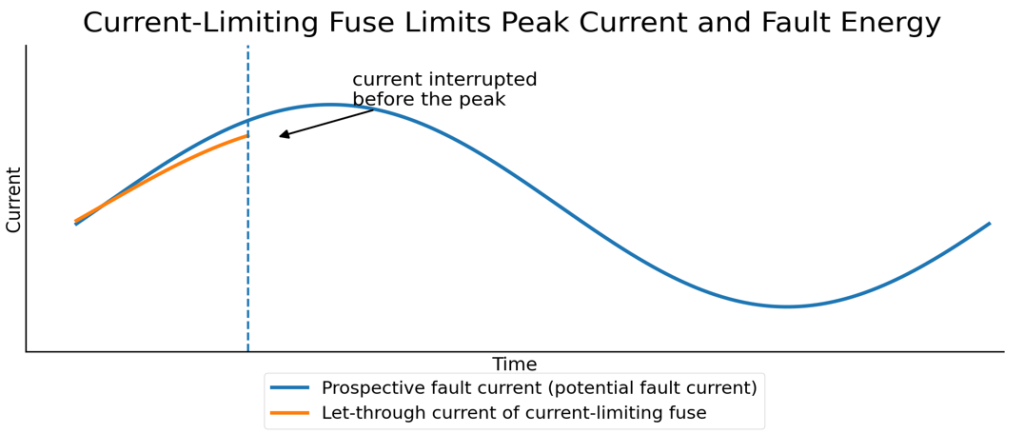
• Its main advantage is reducing peak current and I²t energy, resulting in lower thermal and mechanical stress on equipment.
• Because the interruption process occurs inside the fuse, the external arcing and exhaust effects are much lower.
• Very useful for major faults or applications requiring safer and more compact protection.
| Aspect | Expulsion Fuse | Current-Limiting Fuse |
| Arc extinguishing method | Gas + exhaust from fuse tube | Arc contained inside fuse body |
| External effect | Arc/exhaust can be more visible | More enclosed and controlled |
| Fault current | Interrupts current, but does not greatly limit peak current | Limits peak current and I²t |
| Typical application | Overhead distribution, transformer protection, fuse cutouts | Major faults, high-value equipment, areas requiring low fault energy |
| Simple impression | Simpler and easier to inspect | Faster, more compact, and lower fault energy |
Relationship with Fault Tamer
In products such as Fault Tamer, these concepts are combined: the expulsion section handles small to medium faults, while the current-limiting section operates during major faults. This is why, during major faults, the external arcing effect appears much lower than with a conventional fuse cutout.
Simple conclusion
Expulsion fuses and current-limiting fuses both still generate an arc when interrupting a fault. The difference lies in how the arc and fault energy are managed. An expulsion fuse extinguishes the arc using gas and exhaust, while a current-limiting fuse limits the current very quickly and contains the arc inside the fuse. Therefore, a current-limiting fuse does not mean there is no arc at all; rather, the arc and fault energy are far more controlled.