

Ground fault or earth fault is one of the most common disturbances in electrical systems, because current leaves the normal path and flows to the earth/ground.
1. What Is a Ground Fault?
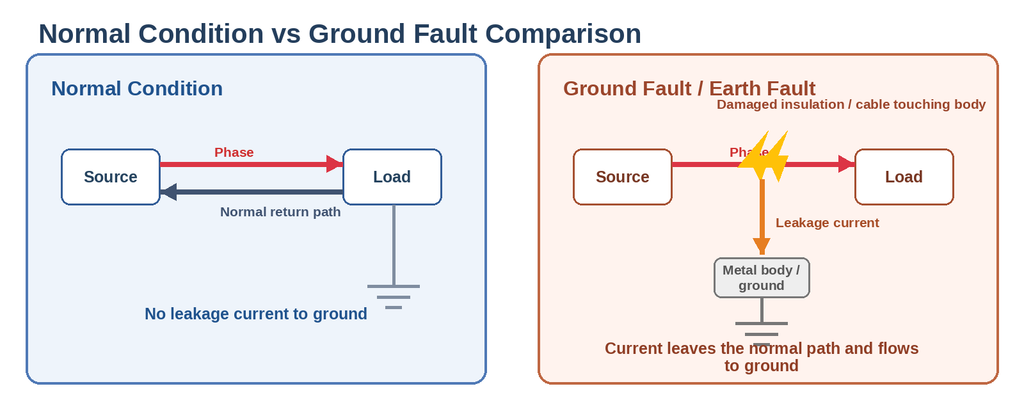
Ground fault is a condition where an active conductor, such as a phase cable, touches the earth, grounding, equipment metal body, or another path connected to ground. As a result, electrical current that should flow through the load leaks to the ground instead. In some references, this condition is also called earth fault, especially in power distribution systems.
2. How Can a Ground Fault Occur?
• Cable insulation is damaged, cracked, peeled, or aged.
• Moisture, water, or conductive dust enters the panel/equipment.
• Bushings, terminals, or connections become dirty, causing tracking.
• Cables are exposed to friction, overheating, or mechanical damage.
• Equipment body is not properly insulated and comes into contact with an active conductor.
3. Difference from Short Circuit and Overload
| Type of Fault | Simple Explanation | Example |
| Ground fault | Phase conductor leaks to earth/ground. | A phase cable touches a panel body. |
| Short circuit | Two points with different potential are directly connected. | Phase-to-phase or phase-to-neutral contact. |
| Overload | Load exceeds the normal capacity. | A motor draws excessive current due to a heavy load. |
4. Why Is a Ground Fault Dangerous?
Ground fault is dangerous because leakage current can make the equipment body energized. If touched by a person, it may create an electric shock risk. In addition, fault current can cause overheating, equipment damage, fire, and operational disturbance because protection devices will trip to isolate the problem area.
5. Protection Used
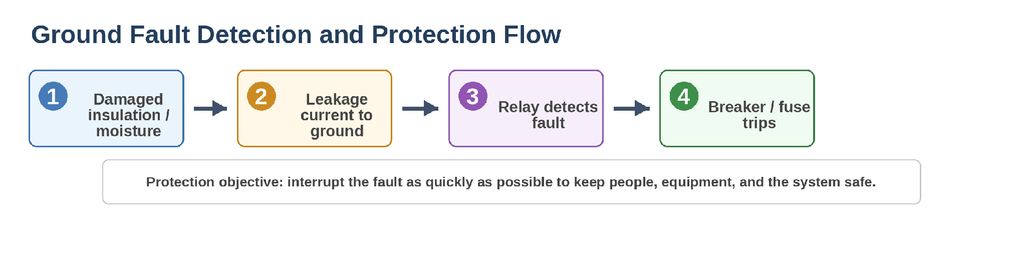
The purpose of ground fault protection is to detect leakage current and interrupt the fault before it endangers people or damages equipment. In low-voltage systems, protection can include ELCB/RCD or earth leakage relay. In distribution/medium-voltage systems, protection can include ground fault relay, overcurrent relay, breaker, fuse, or recloser, depending on the system design and voltage level.
6. How to Reduce Ground Fault Risk
• Ensure the grounding system is properly installed and its resistance meets the design standard.
• Perform visual inspections on cables, terminals, panels, bushings, and damp areas.
• Perform insulation resistance tests to check insulation quality.
• Clean conductive dust or dirt from panels and electrical equipment.
• Follow up immediately on repeated trips, burning smells, tracking marks, or hot cables.
Conclusion
In simple terms, a ground fault is a condition where electrical current leaks to the ground. This disturbance should not be underestimated because it can endanger people, damage equipment, and cause the system to trip. With proper grounding, suitable protection, and routine inspection, ground fault risk can be reduced and electrical system reliability can be improved.