

1. Introduction
In medium-voltage distribution systems, conventional reclosers and IntelliRupter devices are both used to improve service continuity during faults. They can detect fault conditions, interrupt current, and attempt to restore the feeder when the disturbance may be temporary. The main difference is not only the ability to reclose, but how each device tests the line after a fault has been cleared.
2. Conventional Recloser: full-current reclosing
A conventional automatic circuit recloser operates like an intelligent circuit breaker for distribution feeders. When it senses an overcurrent or short circuit, it trips open, waits for a preset dead time, and recloses automatically. If the problem is temporary, supply is restored. If the fault remains, the recloser trips again and may eventually lock out after a preset number of operations.
• Strength: simple, proven, and widely used for overhead feeders with temporary faults.
• Limitation: when it recloses into a permanent fault, the system may experience another high fault-current event.
• Typical impact: repeated voltage sags, thermal stress, mechanical stress, and additional stress on cables, transformers, arresters, and nearby equipment.
3. IntelliRupter PulseCloser: low-energy fault testing
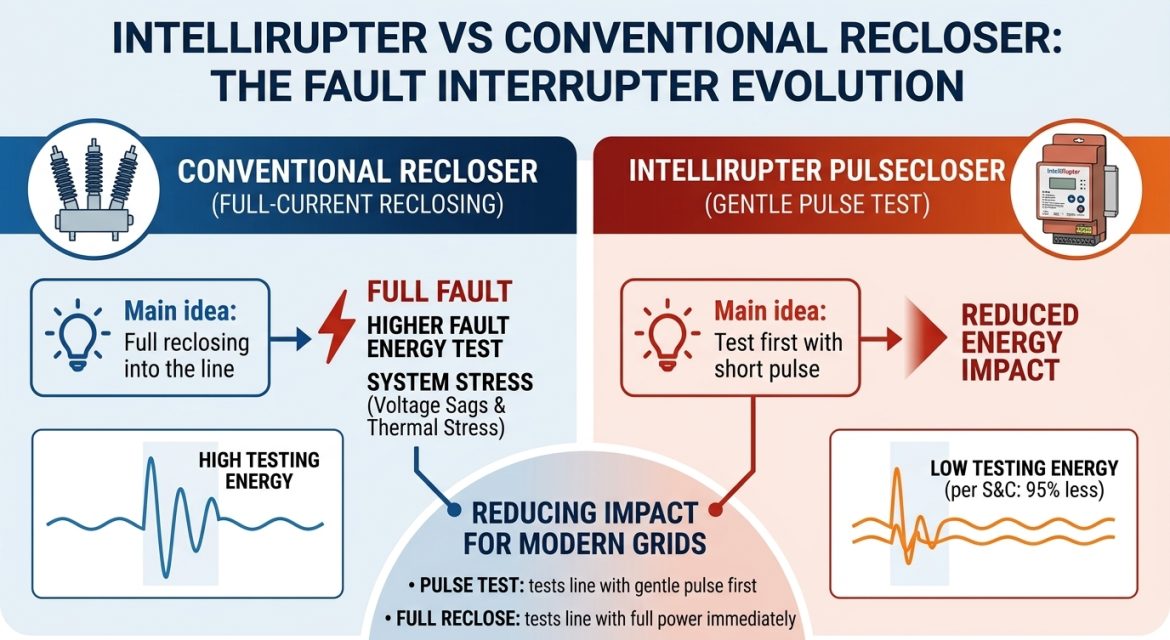
The IntelliRupter PulseCloser Fault Interrupter is an advanced feeder protection and automation device developed by S&C Electric. Instead of directly applying a full reclose to test whether a fault is still present, it uses PulseClosing technology. A short, controlled current pulse is sent to test the circuit before full closing is allowed. This reduces fault-testing energy and lowers system stress compared with conventional reclosing.
• Strength: fault testing is gentler because the line is not immediately exposed to a full fault-current reclose.
• Best fit: feeders that need advanced segmentation, automation, underground-circuit protection, or reduced voltage-sag impact.
4. Operating sequence visualization
Side-by-side Technical Comparison
5. Main differences
| Aspect | Conventional Recloser | IntelliRupter PulseCloser |
| Basic function | Interrupts fault current and automatically recloses after a delay | Interrupts fault current, then tests the line with PulseClosing before full close |
| Fault testing method | Full reclose into the feeder | Short low-energy pulse before full closing |
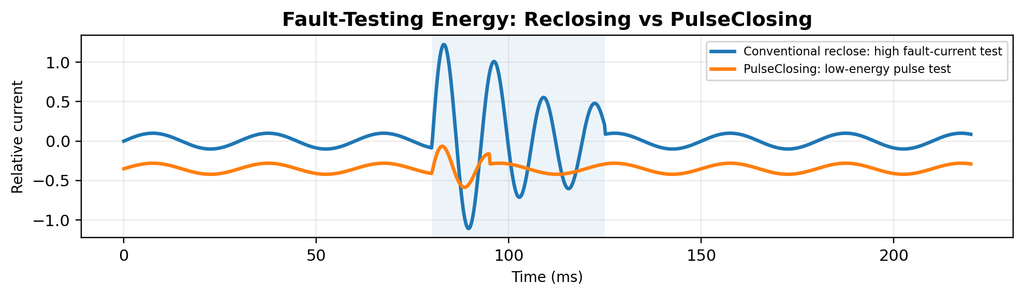
| Energy during test | Higher fault energy if the fault remains | Much lower test energy; S&C states 95% less energy |
| System impact | Greater voltage sag and equipment stress during unsuccessful reclose | Reduced sag impact and lower stress during fault testing |
| Automation value | Protection and automatic service restoration | Protection, segmentation, automation, and restoration support |
| Typical application | Overhead feeders and conventional distribution protection | Modern feeders, loop schemes, underground sections, and smart-grid projects |
6. Fault-testing energy visualization
7. Simple conclusion
A conventional recloser is a proven protection device that improves reliability by automatically restoring feeders after temporary faults. However, its reclosing process may apply full fault current again when the fault is permanent. IntelliRupter uses a different philosophy: test first with a controlled pulse, then close only when conditions are suitable. For systems that require lower fault energy, reduced voltage sag, better segmentation, or advanced automation, IntelliRupter offers a more modern approach. For simpler feeders, a conventional recloser may still be adequate and economical.